

Rigid ideas about manhood are contributing to the climate crisis: New report and policy recommendations

- Published On
- 13 Nov 2026
- Published By
- MenEngage Alliance
- Reading Time
- 5 minutes
- Resource Type
- Press release
Rigid ideas about manhood are contributing to the climate crisis: New report and policy recommendations
Global coalition working with men and boys and ecofeminist network call for policies to address the gendered root causes of the climate crisis
13 November 2026, ANTALYA, Türkiye — Rigid ideas about manhood are contributing to the climate crisis, according to a new report synthesising global research on men, masculinity and climate change. The report reveals that men hold most of the power in the institutions driving global heating, tend to engage in more carbon-intensive practices and express less concern about climate change on average.
Research suggests these trends are rooted in how boys and men are taught from a young age to prize dominance, aggression and power over nature above traits such as care, compassion and nurture.
Grounded in peer-reviewed research from around the world, Cultivating Climate and Gender Justice with Men and Boys: A policy brief has been developed to assist those working on evidence-based policy to address the root causes of the climate crisis.
Alongside evidence around average differences between men and women when it comes to environmental impacts and supporting climate action, the report documents a resurgence of “hypermasculine” authoritarian-style leadership seeking to deny and dismiss global heating, as well as the diverting of funds from climate response into militarism, driven by political agendas built on rigid ideas about gender.
Dr. Stephen Burrell, Lecturer in Criminology at the University of Melbourne, and co-author of the report said:
“There is now a significant body of research from across the globe which demonstrates that restrictive ideas about masculinity are leading to men playing a disproportionate role in ecological destruction. This is bad for people and the planet alike, including for men ourselves. However, it is by no means inevitable. Many men and boys are deeply concerned about climate and gender justice — and there are organisations around the world supporting them to embrace care for nature, in collaboration with feminist movements. But they desperately need help from policymakers (especially men in positions of power!) to recognise the seriousness of the climate crisis, and address the harmful gender norms and social inequalities at its roots.”
Developed by Women Engage for a Common Future (WECF) and MenEngage Alliance, and launching at COP31 in Antalya, Turkey on 14 November 2026, the brief emphasises that these patterns stem not from any “inherent” destructiveness in men towards nature, but from societal systems and structures. Indeed, evidence shows that many men and boys experience climate anxiety, although stereotypes around how they should be as a man can prevent them from expressing their concerns in healthy ways.
The report’s 10 policy recommendations call on policymakers to back gender-transformative policies and programmes. These tackle the gendered root causes of violence, abuse, and poor health and wellbeing, including in the context of environmental disasters. Practical examples of these approaches accompany the report, from Colombia, Uganda, Bangladesh, and Sweden.
The recommendations also stress that gender-transformative action must be tied to a just transition, a wellbeing economy and an urgent phase-out of fossil fuels.
Hanna Gunnarsson, gender expert at WECF and co-author of the brief, said:
“Feminists of the Global Majority have spent decades exposing the colonial, extractive and patriarchal systems driving the climate crisis. Yet climate policy still treats ‘gender’ as shorthand for women and girls. Meanwhile, anti-gender and anti-climate movements are converging: strongman politics offers men who feel insecure easy scapegoats, from feminists and LGBTQI+ people to climate policy. This brief asks how men and boys can go beyond allyship and share responsibility for transforming the norms, institutions and economies that harm people and the planet.”
Laxman Belbase, co-director of MenEngage Alliance and member of its Climate and Environmental Justice Working Group added:
“Solving the climate crisis requires transforming the values and norms tied to patriarchal masculinities, not only infrastructure and policy. Harmful ideals around patriarchal masculinities — the need for men and boys to have power over others — also perpetuates the environmental degradation we witness. As such, addressing patriarchal masculinities will strengthen climate adaptation and resilience as well. MenEngage Alliance, the largest global network working to transform patriarchal masculinities, brings together more than 1,400 members across 92 countries. Together, our members are working as agents of positive change to find transformative ways to contribute to a gender-equitable, ecologically sustainable society alongside women, girls and people of diverse gender identities.”
MenEngage Alliance member and climate activist Sohanur Rahman, Executive Coordinator of YouthNet Global, who is representing the MenEngage Climate and Environmental Justice Working Group at COP31, said:
“The climate crisis is not just an environmental challenge; it is a social one. In Bangladesh, our community project, EcoMen, doesn’t stop at supporting women or planting trees. It also challenges male power and privilege. Positive masculinity without politics isn’t enough. Our approach is pro-care, pro-justice and anti-patriarchal. This grassroots energy has to reach the negotiating table. Climate finance must be accessible and grant-based, and governments and institutions must deliver on their commitments.”
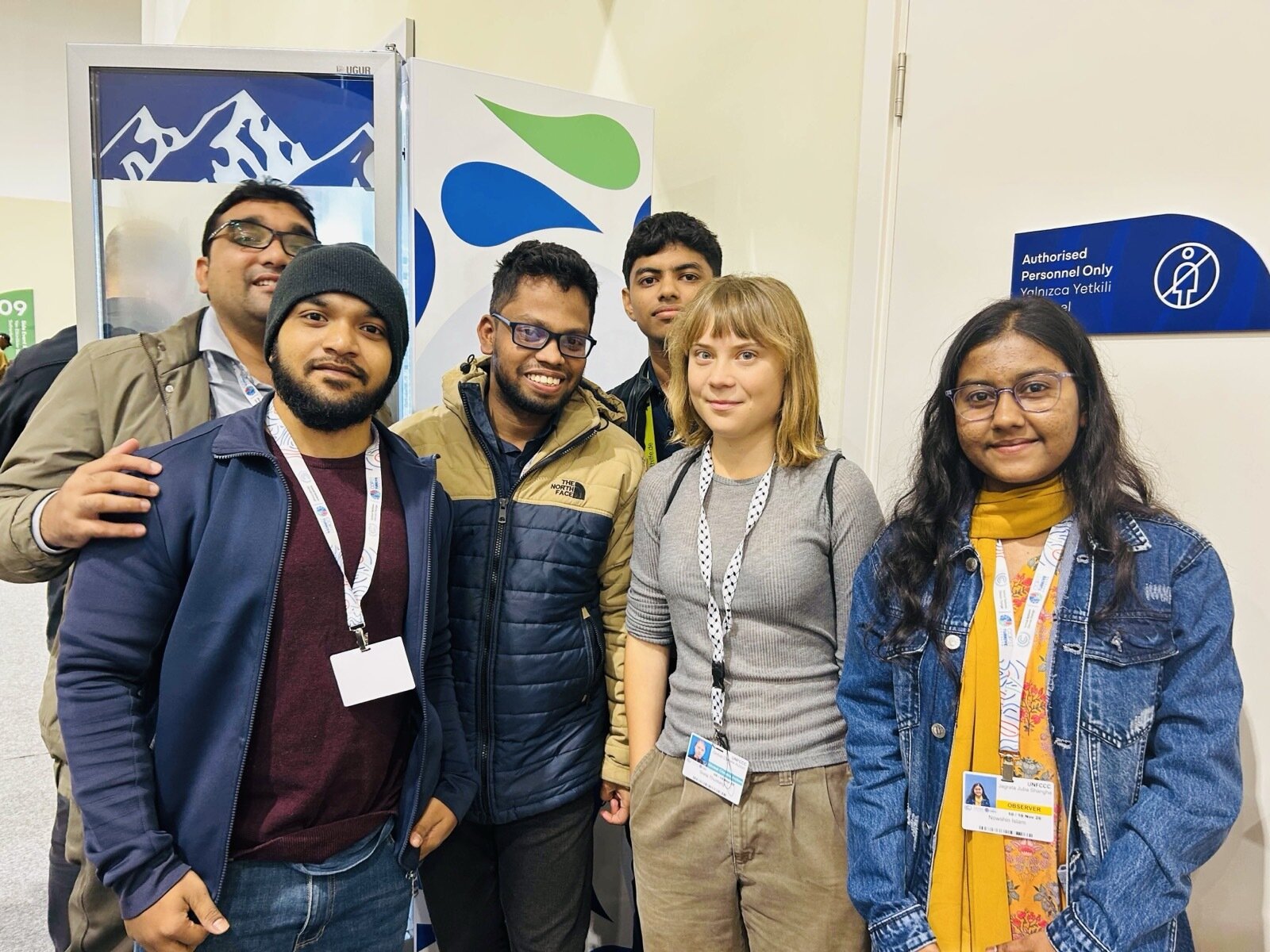
Sohan and YouthNet members at COP31 with Greta Thunberg
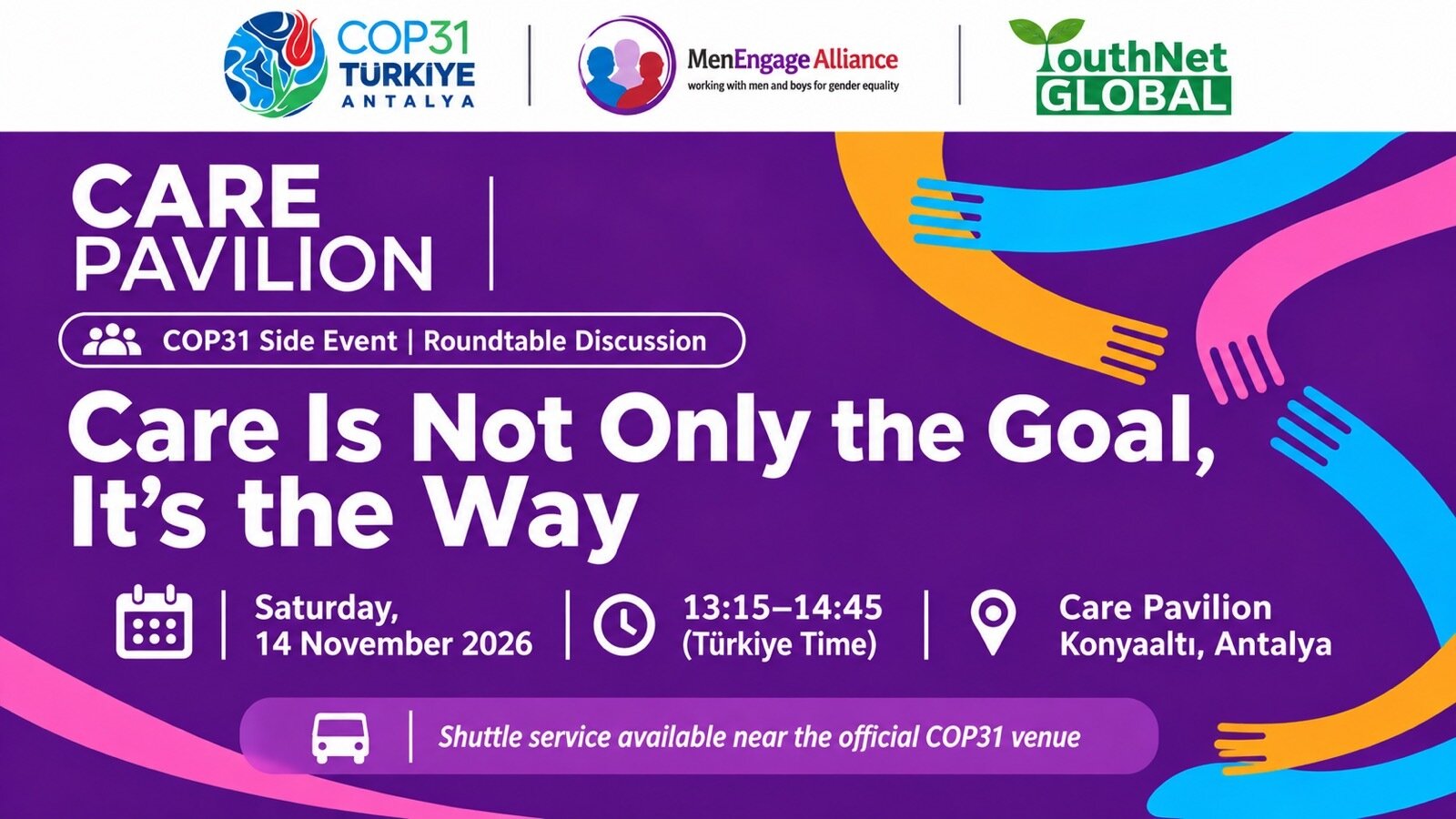
Practitioners working at the intersection of climate justice and with men and boys for gender equality are bringing these recommendations to COP31, including through the event, Care is not only the goal, It’s the way: An open conversation on masculinities and climate justice at 13:15 on on 14 November 2026, at the COP31 Care Pavilion.
Interviews
Dr. Stephen Burrell — remote (he/him) is a Lecturer in Criminology at the University of Melbourne, and an Honorary Fellow at Durham University. He co-hosts a monthly podcast entitled Now and Men: Changing Masculinities, Challenging Norms (nowandmen.net). He can be reached at email hidden; JavaScript is required or email hidden; JavaScript is required for interviews.
Sohanur Rahman (he/him) is the Executive Coordinator of YouthNet Global. He can be reached at email hidden; JavaScript is required for interviews.
Pallavi Dehari (they/she) is the Grassroots Lead from The Gender Lab India. They can be reached at email hidden; JavaScript is required for interviews.
Hanna Gunnarsson - remote (she/her) is a gender expert with WECF who brings more than 10 years advocacy and campaigning experience on gender equality, human rights and environmental issues. She can be reached at email hidden; JavaScript is required for interviews.
About Women Engage For a Common Future
Women Engage for a Common Future (WECF) is an international ecofeminist network of more than 250 women’s and civil society organisations in 70 countries, working for a gender-just and healthy planet for all. A founding member of the UNFCCC Women and Gender Constituency, WECF links grassroots action with advocacy in global policy spaces, and works on climate justice, gender equality and toxic-free environments.
About MenEngage Alliance
MenEngage Alliance is a network of 1,000+ members across 90+ countries that supports and challenges men and boys to break free of stereotypes of what it means to be a man, and work towards women’s rights, LGBTQIA+ rights, climate and gender justice for all.
The MenEngage Climate Justice Working Group, formalised in 2021, is a member-led group of activists, scholars and practitioners with regional representatives from Africa, the Caribbean, Europe, Latin America, South Asia, North America, the Middle East and Oceania.
Media contact
Thalia Pinidis | email hidden; JavaScript is required (English)
Joy Haeusler | email hidden; JavaScript is required (German / English)
Tom Hornbrook | email hidden; JavaScript is required (English / Spanish)